
Source
Where did the information originate?

We transform documents, data and institutional memory into governed knowledge systems that help people retrieve, compare and use information without losing its origin, authority, version or limits.

Begin with the decision that must become possible—not with the largest possible scope.
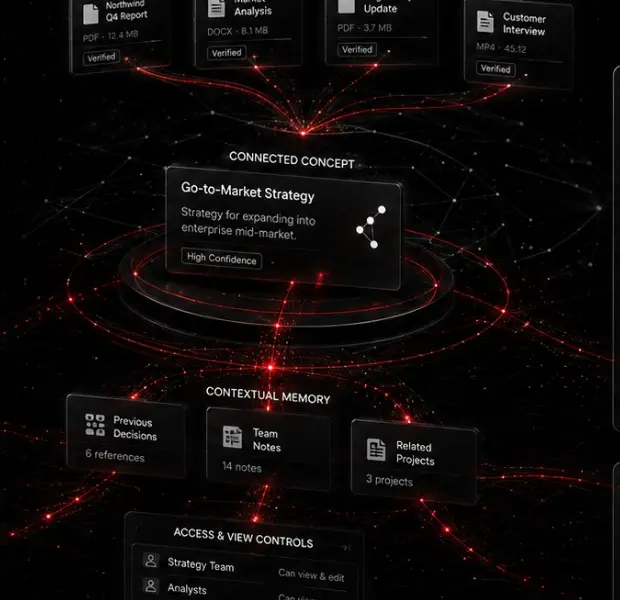
Sources, provenance, access and contextual memory remain visible while information is prepared for retrieval and decision support.
Organisations often possess the information they need but cannot use it reliably. Documents are duplicated, policies conflict, old versions remain searchable, expert decisions live in private inboxes and retrieval tools return fluent text without revealing which source carried authority.
A knowledge system must preserve provenance, permissions, version history, conflict and uncertainty while making information easier to use.
Document and source inventories.
Controlled taxonomies and authority models.
Governed retrieval and question-answering systems.
Institutional memory and decision registers.
Research, policy and compliance workspaces.
Version, conflict and supersession handling.
Role-based access and source-level permissions.
Evaluation sets for retrieval quality and unsupported claims.
Knowledge lifecycle, correction and deletion processes.
Teams find relevant material without losing the source context.
Current and superseded information can be distinguished.
Conflicts become visible instead of being flattened into one answer.
Access rules travel from source to retrieval.
Institutional knowledge survives staff change and fragmented tools.
AI-supported answers can expose evidence, limits and uncertainty.
Documents, records, databases and external sources.
The authority, owner and permitted use attached to each source.
Questions, decision contexts and user roles.
Retention, versioning, correction and deletion requirements.
Known conflicts, missing evidence and high-risk answer categories.
Source inventory and authority model.
Controlled taxonomy and metadata design.
Retrieval, provenance and permission architecture.
Working knowledge interface within the agreed scope.
Evaluation set and acceptance evidence.
Change, correction and knowledge lifecycle process.
Where did the information originate?
Who owns or approves its use?
Which state of the information is current?
Who is allowed to retrieve or act on it?
What is missing, conflicting or not established?
Retrieved text is not treated as verified fact without source context.
Versions, conflicts and superseded records remain visible.
Access is enforced at source and retrieval layers.
The system can state when evidence is missing or insufficient.
Sensitive knowledge is not placed into analytics or unrelated model training.
Knowledge Systems are suited to organisations whose decisions depend on documents, records, expertise or policy that must remain traceable, current and permission-aware.
A governed knowledge system treats provenance, authority, access, versions, conflicts and evaluation as architecture rather than relying on fluent retrieval alone.
Yes. Supersession and conflict should be represented explicitly so the system does not silently erase important history.
The architecture can enforce role and source-level permissions so search convenience does not override authorised use.
Show us the sources, questions and decisions that matter. We will identify what must be structured, governed and evaluated before retrieval can be trusted.