
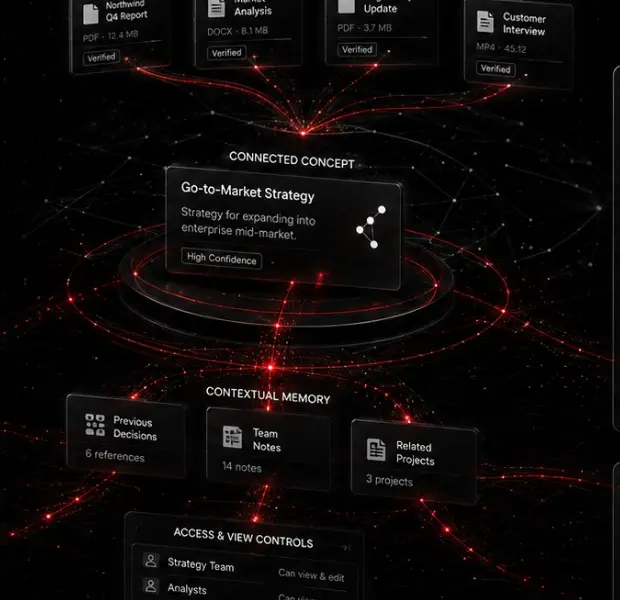











RELESONA AUDIENCE INTELLIGENCE PLATFORM
Separate product environment

RELESONA develops products, research programmes, engineering frameworks, technology directions, architectures and controlled system layers. These categories are deliberately separated so a future direction is never presented as a released capability.

The role comes before the name. Each surface states whether it is an operating destination, controlled research, an engineering system or a future direction.
A separate product environment with its own accounts, policies and operating evidence.
The corporate entrance explains it; the platform operates at relesona.com.
A research and engineering programme examined through explicit human authority and evaluation gates.
No public lab, product availability, sentience or autonomous authority is claimed.
Creation, audience intelligence, knowledge and agentic layers that describe how capability is structured.
A named architecture is not automatically a standalone released product.
A controlled content architecture for approved material, provenance and future access states.
No catalogue, checkout, payment, entitlement or delivery is active here.
The portfolio connects people, knowledge, context and machine capability while preserving the boundary between the existing Relesona Audience Intelligence Platform, ERVIE AI research and the supporting engineering layers.
The Relesona Audience Intelligence Platform is designed to make audience relationships, context and demand more intelligible. It treats people as participants in an ecosystem—not as anonymous traffic.
ERVIE AI — Emotionally Responsive Virtual Intelligence Entity — is RELESONA TECHNOLOGIES’ research and engineering programme for emotionally responsive, context-aware virtual intelligence designed to preserve continuity, adapt interaction and operate within explicit human authority.
EMMVIE AI is the continuity and application architecture under ERVIE AI. It defines how authorised signals, approved memory, contextual meaning, declared values, identity boundaries and accumulated experience may influence interaction without converting inference into unquestionable truth.
The Creation Engine structures goals, constraints, knowledge and decisions into the materials required to design and build a system. It connects discovery, architecture, prototyping and verification within one documented process.
This architecture is designed to interpret relationships between creative work, audience response and demand while preserving context and data boundaries. It supports decisions through traceable signals rather than isolated vanity metrics.
Knowledge Fabric provides the architecture for connecting information while retaining provenance, access rules, version history and context. Its purpose is to make knowledge reusable without separating it from its origin or authority.
Agentic Runtime defines how agents receive context, use tools, request approval, escalate uncertainty and record actions. It establishes the operational boundary between delegated automation and accountable human control.
Content Store is a proposed controlled layer for organising approved publications, learning packs, media assets and licensed digital material while preserving source, version, ownership, access and delivery-readiness boundaries.
Shared principles and architecture do not erase product boundaries. Availability, responsibility, evidence and operating ownership remain separately stated for every entry.
Roles, authority and evidence remain explicit for each system.
Separate product environment
Human-directed research and evaluation
The supporting entries remain anchored on this page until each has enough verified material, ownership and release evidence to justify an independent public destination.
EMMVIE AI is the continuity and application architecture under ERVIE AI. It defines how authorised signals, approved memory, contextual meaning, declared values, identity boundaries and accumulated experience may influence interaction without converting inference into unquestionable truth.
EMMVIE is not automatically a foundation model, a psychological diagnosis engine or permission to infer hidden emotions, merge private personas or manipulate vulnerable users.
The Creation Engine structures goals, constraints, knowledge and decisions into the materials required to design and build a system. It connects discovery, architecture, prototyping and verification within one documented process.
An engineering framework is not a released standalone product or autonomous idea generator.
This architecture is designed to interpret relationships between creative work, audience response and demand while preserving context and data boundaries. It supports decisions through traceable signals rather than isolated vanity metrics.
No audience metric, prediction or identity claim is published without a defined source, consent basis, freshness rule and evaluation context.
Knowledge Fabric provides the architecture for connecting information while retaining provenance, access rules, version history and context. Its purpose is to make knowledge reusable without separating it from its origin or authority.
Connected information does not become authoritative merely because it is searchable or machine-readable.
Agentic Runtime defines how agents receive context, use tools, request approval, escalate uncertainty and record actions. It establishes the operational boundary between delegated automation and accountable human control.
The runtime does not grant blanket authority. Every tool, action and escalation path must be deliberately configured.
Content Store is a proposed controlled layer for organising approved publications, learning packs, media assets and licensed digital material while preserving source, version, ownership, access and delivery-readiness boundaries.
No public catalogue, checkout, payment, membership entitlement, licence grant, account-backed download or delivery is active through this corporate website.
No. AI is used where it creates defensible value. Many engagements also require conventional software, data, integration, interface, security or operating-process engineering.
Compliance depends on the actual system, role allocation, data flows, use case, jurisdiction and operation. RELESONA does not make universal compliance claims without project-specific analysis and evidence.
Only within deliberately configured permissions, tools, approval rules and accountability boundaries.
ERVIE AI is currently presented as a research and engineering programme, not as generally available production software.
No. The platform is a separate product environment. The corporate website presents the company, services, technology portfolio and research direction.
RELESONA can help determine whether the requirement belongs inside an existing product, a controlled engineering layer, a research programme or a new custom system.